The Physics of Lateral Sound Reflections
The human auditory system perceives the dimension and majesty of a room through binaural disparity—the minute differences in phase, arrival time, and frequency spectrum received by our left and right ears. In a wide fan-shaped auditorium, the first sound reflections arrive from the ceiling, hitting both ears simultaneously in phase.
In contrast, a narrow shoebox hall (typically between 19 and 23 meters wide) ensures that sound reflects off the rigid side walls and strikes the listener's ears laterally within 15 to 30 milliseconds after the direct sound. This phenomenon, known as the Initial Time Delay Gap (ITDG), triggers an expansive sensation of acoustic envelopment ($LEV$), making the orchestra seem broad and immersed in sound.
Vienna: The Empiric Gold Standard
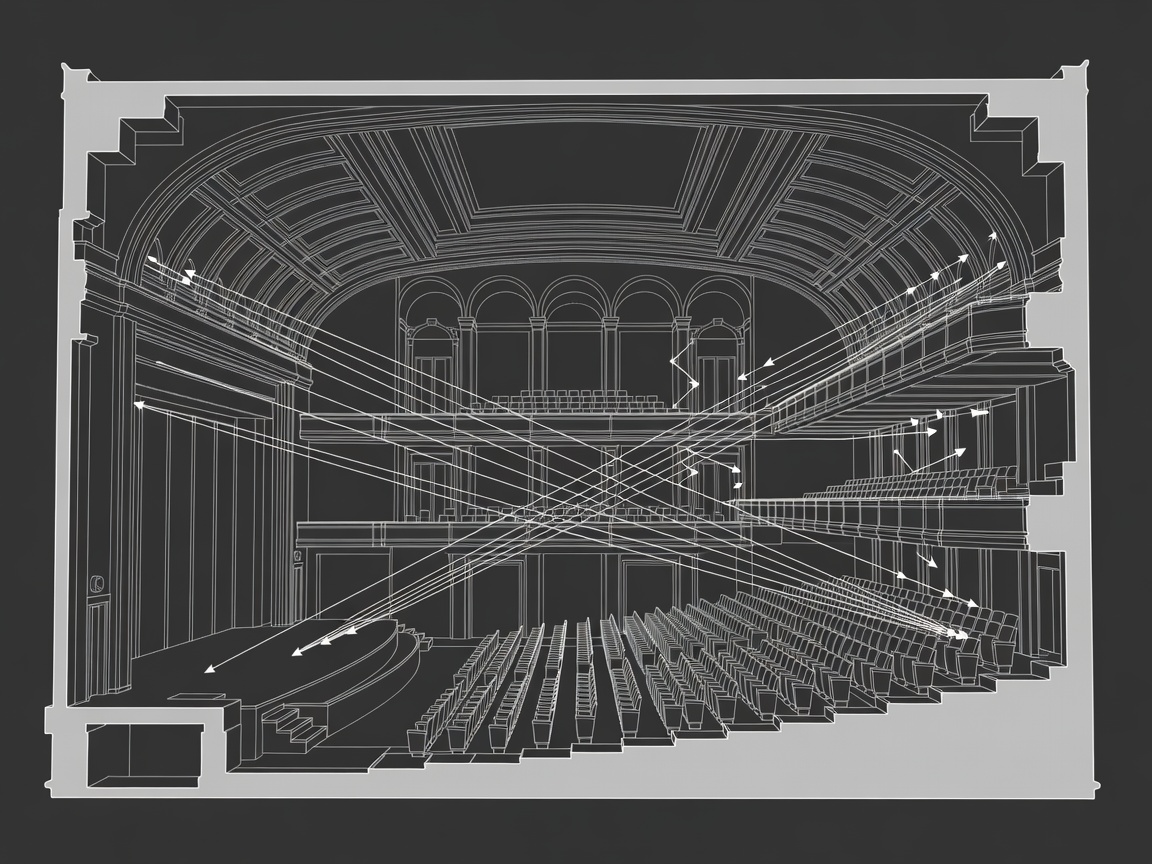
Completed in 1870, the Grosser Musikvereinssaal measures 48.8m long, 19.1m wide, and 17.75m high. Architect Theophil Hansen had no grasp of decibels or modern formulas, yet created sonic magic through decorative necessity:
- Gilded Caryatids: Act as irregular mathematical diffusers scattering frequencies between 1,000 Hz and 4,000 Hz.
- Hollow Floor Planking: Acts as a compliant membrane absorber preventing muddy build-up around 80–120 Hz.
- Coffered Plaster Ceilings: Disperse vertical reflections back down uniformly into the audience rake.
Boston: The Scientific Birth of Acoustics
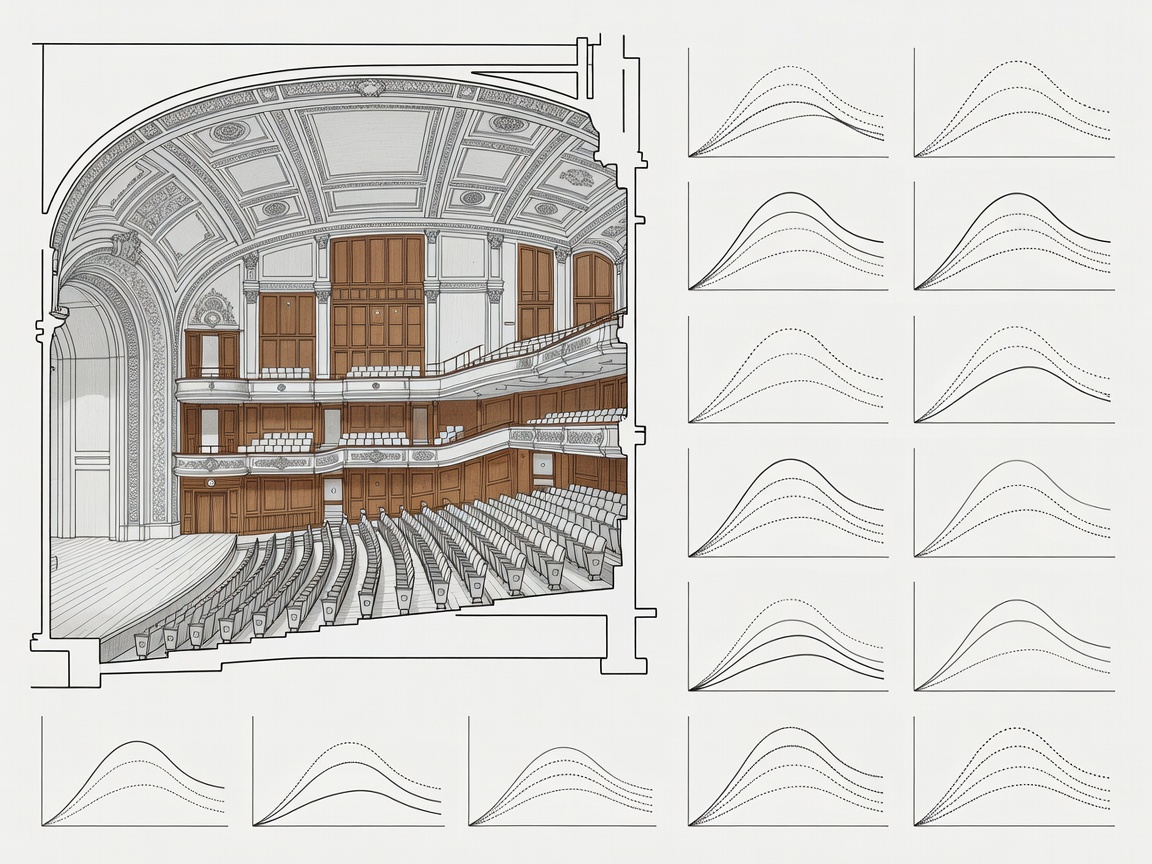
In 1900, Harvard physicist Wallace Clement Sabine was commissioned by McKim, Mead & White to engineer the Boston Symphony Hall. Sabine instituted the world's first quantitatively measured concert room:
- Calculated Absorption: Sabine measured hair-felt cushions and audience clothing absorption factors.
- Statue Niches: Modeled after the Greek Theatre at Pompeii, 16 classical figures in upper recesses scatter high-end flutter echo.
- Narrow Shallow Stage: Compresses orchestral sound before launching it out into the hall.
The Vineyard Alternative: Scharoun's Disruption
While the shoebox offers unparalleled acoustic blend, it distances back-row listeners up to 45 meters from the podium. In 1963, Berlin Philharmonie introduced the "vineyard" configuration: seating surrounding the orchestra in terraced balconies. By turning balcony boundary fascias into reflecting walls, vineyard halls produce lateral energy without requiring a narrow shoebox shell.
Compare Hall Metrics